
Standard Cleanroom Wall Panel Materials: Types & Selection Guide
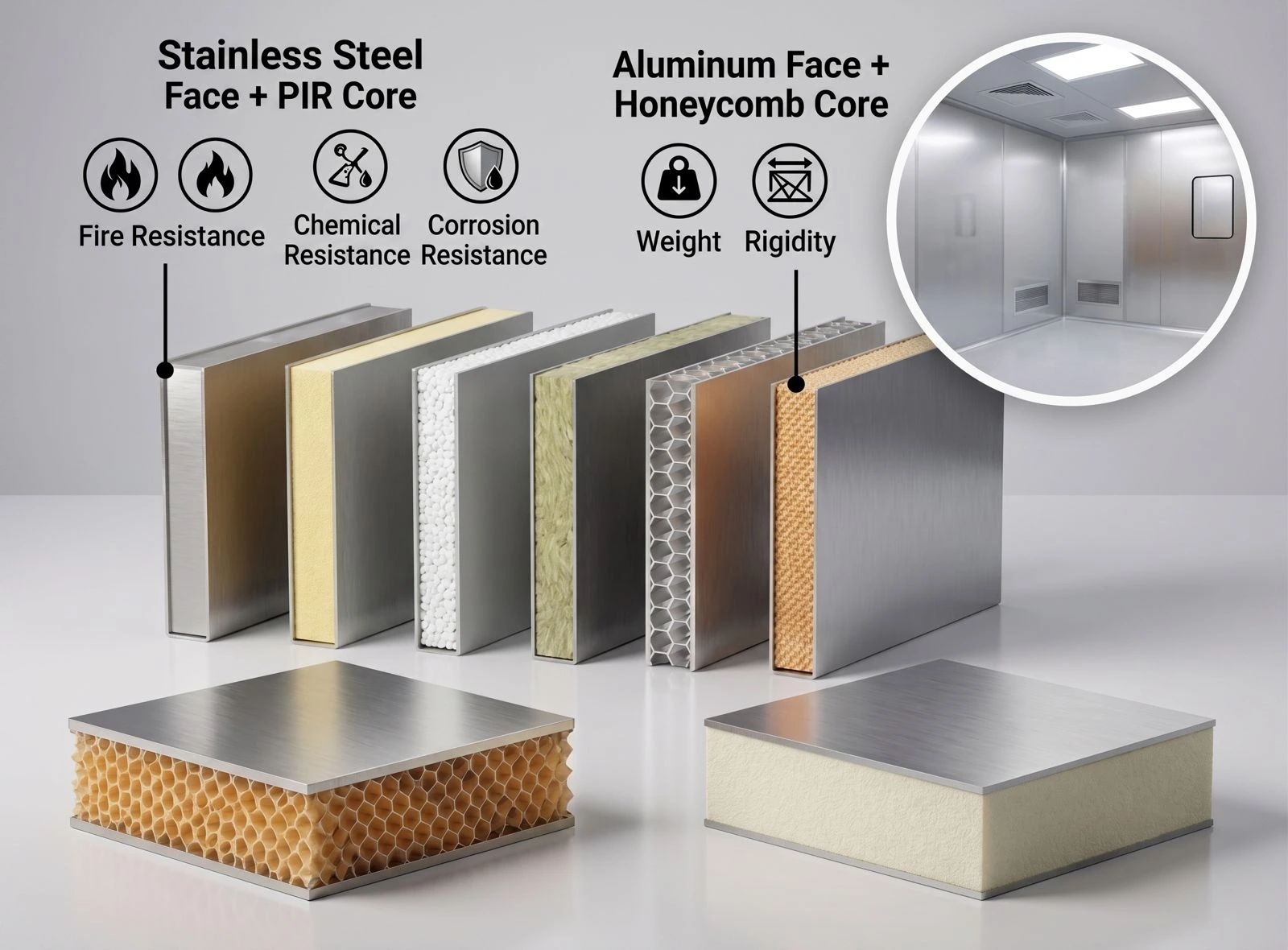
When you are designing a pharmaceutical cleanroom, the wall panel material is not simply a matter of appearance or cost. The wall system has to support contamination control, cleaning, durability, temperature control, and the day-to-day demands of the manufacturing environment.
A cleanroom wall should provide a smooth, easy-to-clean surface, minimize areas where contaminants can collect, and remain stable under repeated cleaning and sanitization. The right choice also depends on the room classification, manufacturing process, chemicals used, fire-safety requirements, insulation needs, and overall project design.
So, what materials are commonly used for cleanroom wall panels?
The most common options include PPGI, stainless steel, aluminium-based panels, HPL, Rockwool sandwich panels, and PUF sandwich panels. The best option is not necessarily the most expensive one. It is the material that matches the actual requirements of the facility.
For pharmaceutical and other controlled environments, panel selection should therefore be considered as part of the complete cleanroom design rather than as an isolated construction decision.
What Makes a Good Cleanroom Wall Panel?
Before comparing individual materials, it is useful to understand what a cleanroom wall system is expected to do.
A well-designed cleanroom wall should generally provide:
- A smooth and hygienic surface
- Easy cleaning and sanitization
- Resistance to the chemicals used in the facility
- Good mechanical durability
- Appropriate fire performance
- Suitable thermal insulation
- Minimal particle generation
- Properly sealed joints
- Compatibility with doors, windows, ceilings, and other cleanroom components
The exact specification should be selected according to the application and project requirements rather than using the same panel construction for every room.
Standard Materials Used for Cleanroom Wall Panels
The following are the most commonly used materials for cleanroom wall panels in pharmaceutical and controlled environments.
PPGI Cleanroom Wall Panels
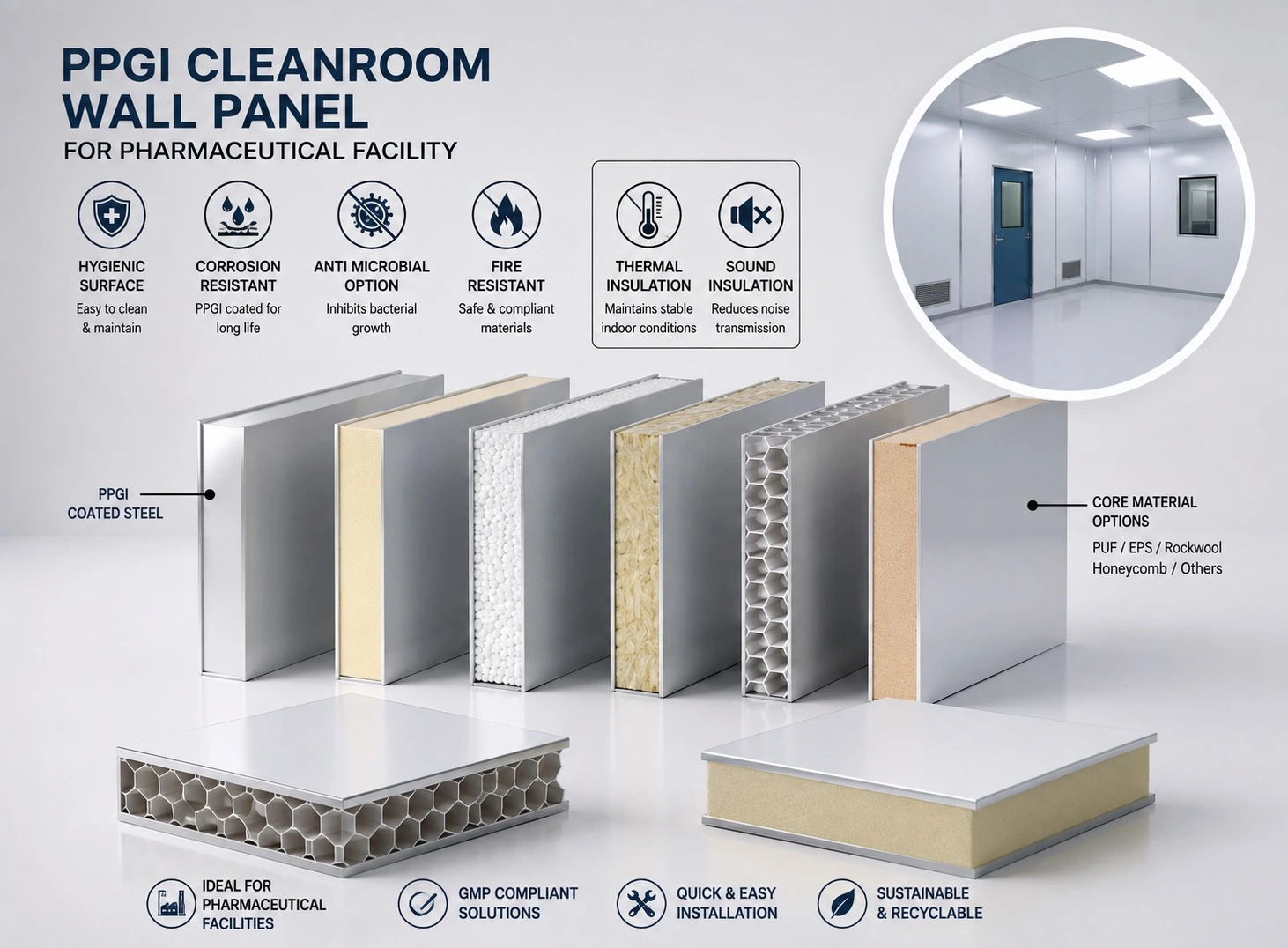
PPGI (Pre-Painted Galvanized Iron/Steel) is one of the commonly used materials for modular cleanroom wall panels.
The galvanized steel substrate provides structural strength and corrosion protection, while the pre-painted surface creates a smooth finish that can be cleaned and maintained as part of a suitable cleanroom cleaning program.
Key Benefits
- Good corrosion resistance
- Smooth, easy-to-clean surface
- Good mechanical strength
- Cost-effective compared with some premium materials
- Available in different finishes
- Suitable for modular cleanroom construction
- Relatively easy to maintain
Typical Applications
PPGI panels can be considered for:
- Pharmaceutical manufacturing areas
- Packaging areas
- Biotechnology facilities
- Food processing environments
- Cosmetic manufacturing
- Supporting cleanroom areas
For many projects, PPGI provides a practical balance between performance, durability, and project cost.
However, the coating specification matters. Pharmaceutical facilities should consider the cleaning chemicals, frequency of sanitization, impact exposure, and environmental conditions before finalizing the panel.
Stainless Steel Cleanroom Wall Panels
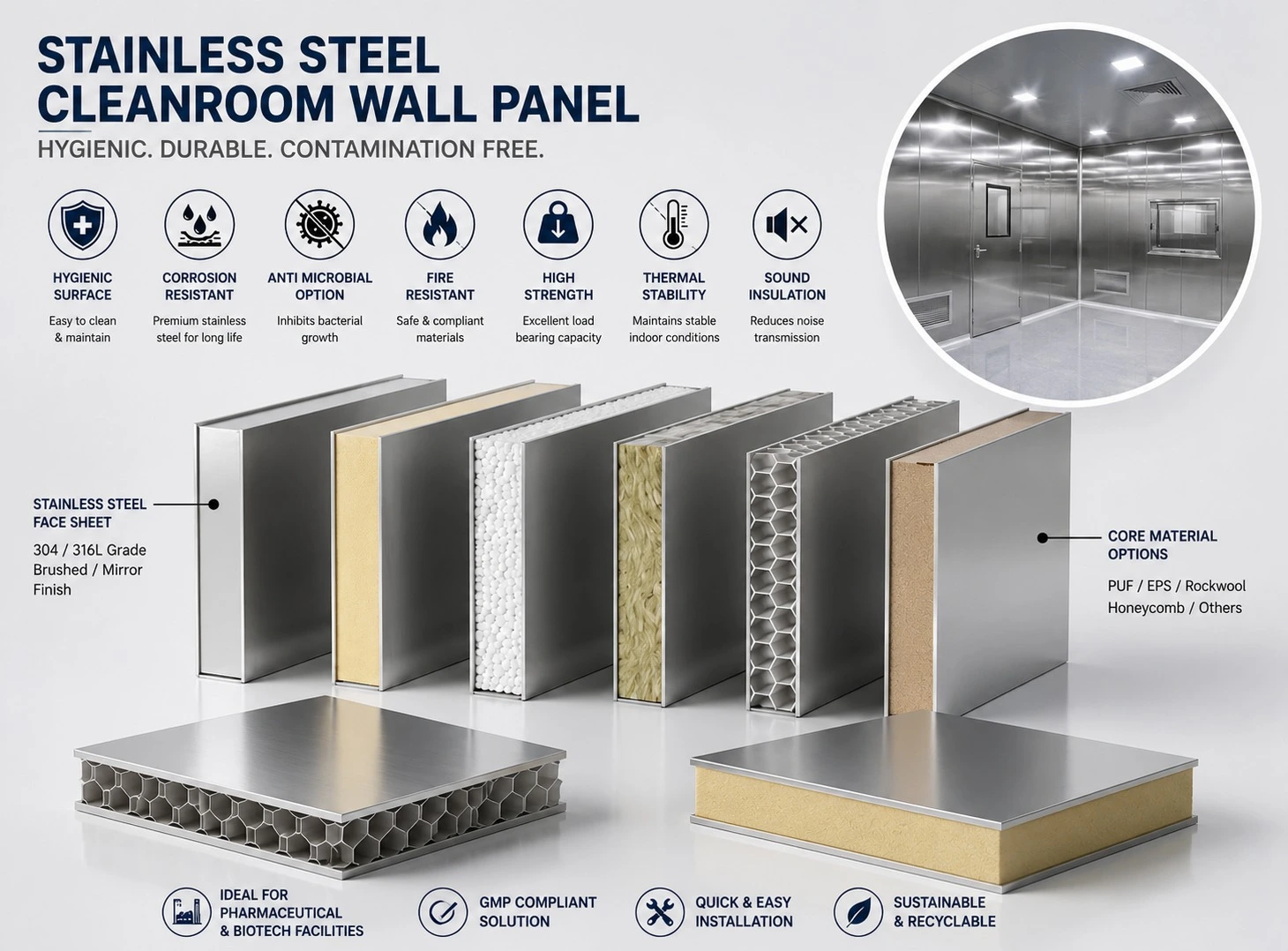
When hygiene, corrosion resistance, and frequent cleaning are major priorities, stainless steel is a widely considered option.
SS304 and SS316 are common stainless-steel grades, although the appropriate grade should be selected based on the actual environment and chemical exposure.
Stainless steel provides a durable, non-porous surface that can withstand demanding cleaning conditions when properly specified and fabricated.
Key Benefits
- Excellent corrosion resistance
- Durable construction
- Smooth and hygienic surface
- Good resistance to many cleaning chemicals
- Easy to clean and sanitize
- Long service life when properly maintained
Typical Applications
Stainless steel panels may be used in:
- Sterile pharmaceutical areas
- Injectable manufacturing facilities
- Vaccine and biotechnology facilities
- Research laboratories
- Critical processing areas
- Healthcare environments
The initial cost can be higher than some coated-steel alternatives, but stainless steel can be a strong choice where long-term durability and chemical resistance are important.
Aluminium Composite Panels
Aluminium Composite Panels (ACP) consist of aluminium skins bonded to a core material. They are lightweight and can provide an attractive, clean architectural finish.
They may be suitable for certain controlled environments and supporting areas, but the specific ACP construction and core should be carefully evaluated before using them in a critical pharmaceutical cleanroom.
Key Benefits
- Lightweight
- Good corrosion resistance
- Attractive finish
- Easy handling and installation
- Low routine maintenance
Typical Applications
ACP may be considered for:
- Supporting cleanroom areas
- Laboratories
- Electronics facilities
- Utility or ancillary spaces
- Areas where architectural appearance is important
For critical pharmaceutical environments, the panel specification should be evaluated against the cleaning, fire, hygiene, and contamination-control requirements of the room.
High Pressure Laminate Panels
High Pressure Laminate (HPL) panels are manufactured using layers of paper-based material impregnated with resin and consolidated under high pressure.
HPL can provide a durable decorative surface with good resistance to everyday wear.
Key Benefits
- Good scratch resistance
- Good impact resistance
- Easy to clean
- Attractive finish
- Good surface durability
- Available in different finishes
Typical Applications
HPL can be used in:
- Laboratories
- Healthcare facilities
- Diagnostic areas
- Educational laboratories
- Supporting controlled environments
As with any panel material, the actual surface and core construction should be matched to the cleaning chemicals, hygiene requirements, and classification of the room.
Rockwool Sandwich Panels
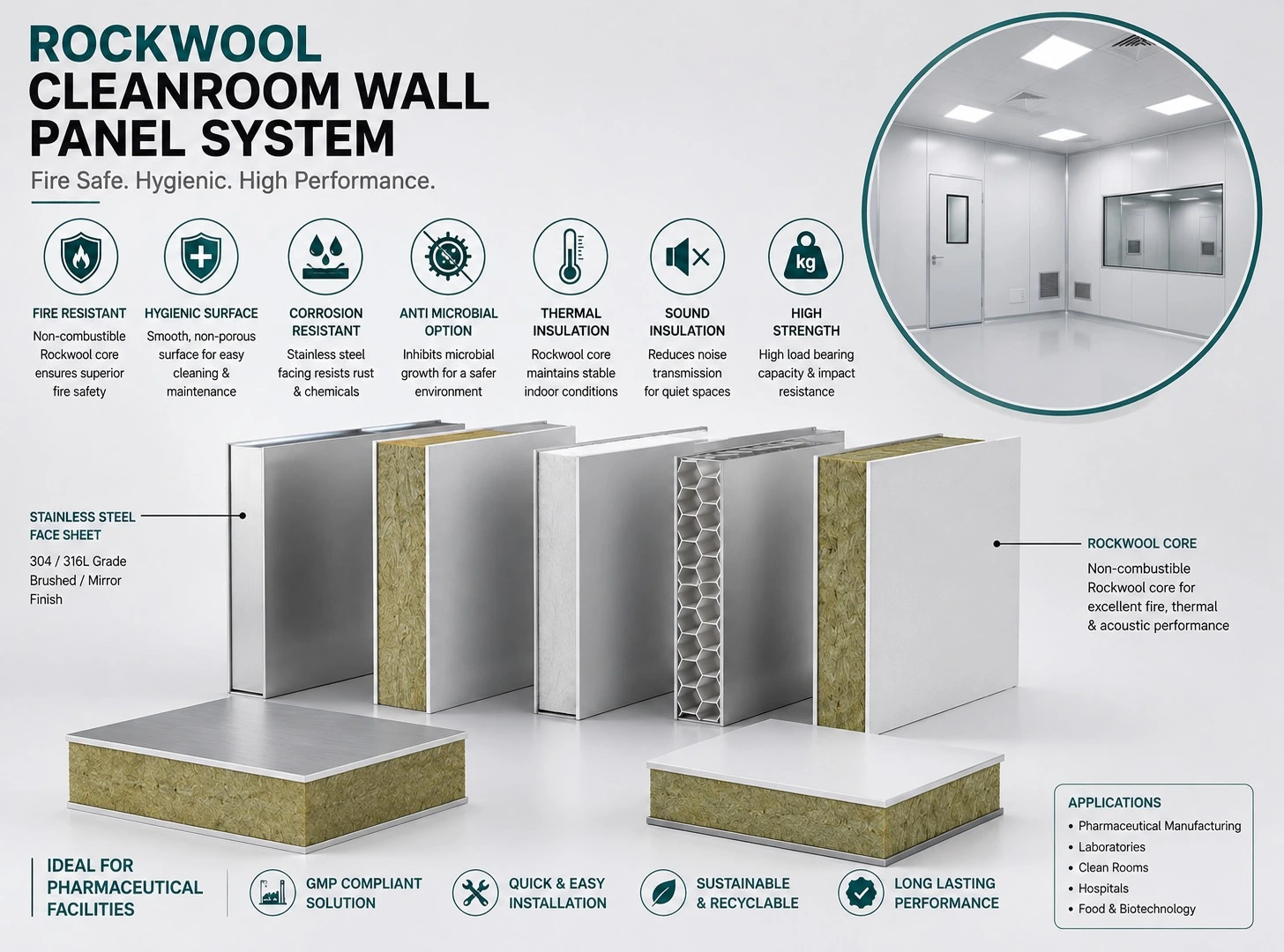
Rockwool cleanroom panels use mineral wool as the insulating core between metal facings.
Their major advantage is fire performance, along with thermal and acoustic insulation.
Key Benefits
- High fire resistance potential
- Good thermal insulation
- Good sound insulation
- Strong panel construction
- Suitable for applications where fire performance is important
Typical Applications
Rockwool panels are commonly considered for:
- Pharmaceutical facilities
- Industrial cleanrooms
- Chemical manufacturing areas
- Fire-sensitive applications
- Controlled manufacturing environments
If fire safety is a major project requirement, Rockwool can be an important panel option to evaluate.
The final fire rating, however, depends on the complete tested panel construction, including the core, facings, joints, and installation system.
PUF Cleanroom Wall Panels
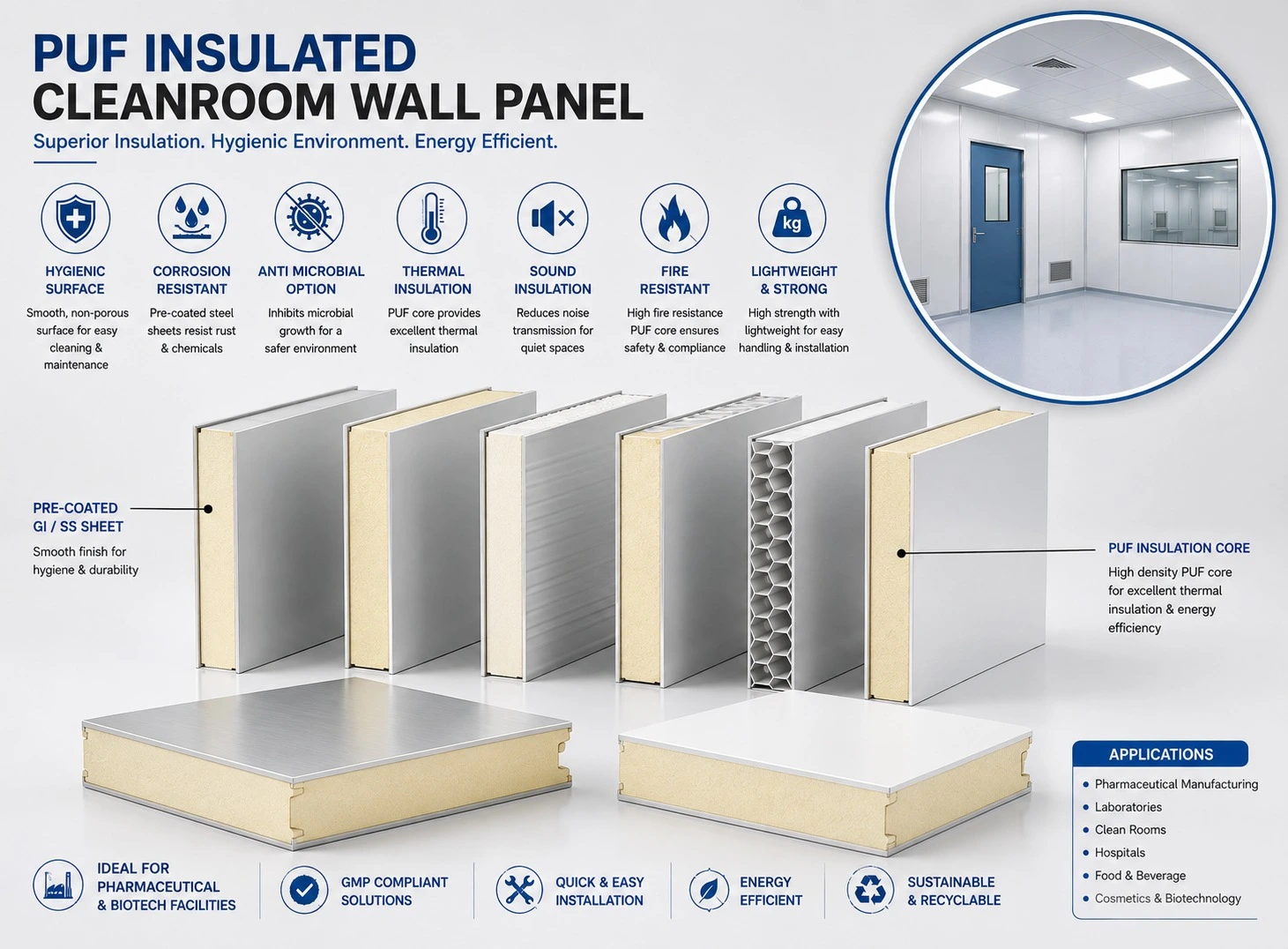
PUF (Polyurethane Foam) sandwich panels use polyurethane foam as the insulating core.
PUF is widely used where thermal insulation is an important consideration.
Key Benefits
- Good thermal insulation
- Lightweight construction
- Energy-efficient insulation
- Relatively quick installation
- Good structural performance
Typical Applications
PUF panels can be used in:
- Pharmaceutical cleanrooms
- Food processing facilities
- Cold rooms
- Biotechnology facilities
- Temperature-controlled areas
The insulation performance can help the HVAC system maintain the required environmental conditions efficiently. However, the panel should always be selected according to the complete fire, hygiene, temperature, and regulatory requirements of the project.
What Materials Are Used Inside Cleanroom Panels?
The outer facing is only one part of a sandwich-panel system. The core material also has a major effect on the panel's thermal, fire, acoustic, and structural performance.
Common cleanroom panel cores include:
- Polyurethane Foam (PUF)
- Rockwool
- PIR (Polyisocyanurate)
- Honeycomb cores
- EPS (Expanded Polystyrene)
Each core behaves differently.
For example, Rockwool is often selected where fire performance is a major consideration, while PUF is commonly selected for thermal insulation.
The correct selection depends on the project specification rather than simply choosing the material with the lowest price.
PPGI vs Stainless Steel: Which Is Better?
There is no universal answer.
For a pharmaceutical project, the decision should be based on the room's operating conditions.
← Swipe table horizontally to view all columns →
| Factor | PPGI | Stainless Steel |
|---|---|---|
| Initial cost | Generally lower | Generally higher |
| Corrosion resistance | Good | Excellent |
| Cleaning | Easy with suitable finish | Excellent |
| Durability | Good | Very high |
| Chemical exposure | Depends on coating | Generally excellent |
| Appearance | Smooth painted finish | Metallic finish |
| Critical hygiene areas | Application dependent | Often preferred |
| Maintenance | Relatively easy | Relatively easy |
The important point is that panel performance depends on the complete system, not just the name of the facing material.
A pharmaceutical facility should consider the room classification, cleaning agents, process requirements, fire safety, temperature conditions, expected impact, and lifecycle cost before selecting the panel.
How Should Pharmaceutical Companies Select Cleanroom Wall Panels?
When comparing cleanroom wall panels, ask these questions before making a decision.
1. What cleaning chemicals will be used?
Frequent exposure to disinfectants and cleaning agents can affect some coatings and finishes. Select a surface designed for the actual cleaning regime.
2. What level of hygiene is required?
Critical areas may require more robust, hygienic, and corrosion-resistant surfaces than supporting areas.
3. Is fire resistance important?
If fire performance is a key requirement, evaluate systems such as Rockwool or other appropriately tested constructions.
4. What level of thermal insulation is required?
The panel core can influence the HVAC load and temperature stability of the facility.
5. How much mechanical impact will the walls receive?
Production areas with frequent movement of equipment and materials may require a more durable construction.
6. How will the joints be sealed?
A high-quality panel can still perform poorly if joints, corners, penetrations, and interfaces are not properly designed and sealed.
7. What are the project and regulatory requirements?
Panel specifications should be aligned with the facility's applicable GMP, ISO, fire-safety, validation, and engineering requirements.
Essential Features of a Good Cleanroom Wall System
A cleanroom wall panel should be considered together with its joints and accessories.
Important characteristics can include:
- Smooth surface finish
- Properly sealed joints
- Flush or hygienic interfaces
- Low particle-shedding surfaces
- Moisture resistance
- Chemical resistance
- Corrosion protection
- Appropriate insulation
- Good mechanical strength
- Easy cleaning and maintenance
- Compatibility with cleanroom doors and windows
- Proper integration with ceilings and HVAC systems
For pharmaceutical facilities, details such as wall-to-floor junctions, corners, service penetrations, and door interfaces can be just as important as the panel itself.
Where Are Cleanroom Wall Panels Used?
Cleanroom wall systems are used across several industries.
Pharmaceutical Manufacturing
Used in manufacturing, formulation, packaging, sterile areas, and other controlled environments.
Biotechnology
Used in laboratories, research environments, cell-culture areas, and biotechnology production.
Medical Device Manufacturing
Used where controlled environments are required during the production or assembly of medical devices.
Electronics
Used in manufacturing environments where contamination and particulate control are important.
Food Processing
Used in hygienic processing and packaging environments.
Healthcare and Research
Used in selected laboratories, controlled healthcare environments, and research facilities.
Cleanroom Wall Panel Maintenance
Even the best panel system requires proper maintenance.
A practical maintenance program should include:
- Regular cleaning using approved chemicals
- Avoiding abrasive tools that can damage surfaces
- Periodic inspection of joints and sealants
- Checking for dents, scratches, corrosion, or coating damage
- Repairing damaged surfaces promptly
- Inspecting doors, windows, corners, and service penetrations
- Following the facility's approved cleaning and maintenance procedures
Maintenance should be documented as part of the facility's quality and engineering procedures where applicable.
Why Panel Quality Matters Over the Long Term
The cheapest panel is not always the lowest-cost solution.
A cleanroom wall system affects:
- Cleaning time
- Maintenance requirements
- Durability
- Energy performance
- Contamination control
- Facility downtime
- Lifecycle cost
A well-specified panel system can therefore provide value throughout the operating life of the facility.
For pharmaceutical manufacturers, the goal should be to select a system that delivers the required performance consistently—not simply to minimize the initial purchase price.
Why Choose Luckydeep Cleanroom?
Luckydeep Cleanroom is a trusted manufacturer and supplier of modular cleanroom systems for pharmaceutical, biotechnology, food processing, and other controlled environments.
We offer a comprehensive range of cleanroom wall panels, including PPGI, stainless steel, Rockwool, PUF, and customized panel systems designed to meet your specific facility requirements.
Our approach focuses on:
- Understanding your project requirements before recommending a panel system
- Providing panels that meet applicable GMP, ISO, and fire-safety standards
- Customized panel dimensions, facings, cores, and finishes
- Complete cleanroom solutions including walls, ceilings, doors, and accessories
- Technical support from design through installation
- Consistent quality and reliable delivery
Whether you need modular cleanroom wall panels for a new facility or are upgrading an existing cleanroom, Luckydeep Cleanroom can help you select the right panel system for your application.
Contact us to discuss your cleanroom wall panel requirements.
Frequently Asked Questions
Common cleanroom wall panel materials include PPGI, stainless steel, Rockwool, PUF, aluminium composite panels and HPL, depending on the application and project requirements.
There is no single best panel for every pharmaceutical facility. The selection depends on hygiene requirements, cleaning chemicals, fire performance, thermal insulation, mechanical exposure and the specific room application.
PPGI panels can be suitable for pharmaceutical cleanrooms when the panel construction, coating, joints, sealants and installation are appropriately specified for the intended environment.
PPGI generally provides a practical balance between performance and cost, while stainless steel offers higher corrosion resistance and can be advantageous in demanding cleaning or chemical-exposure environments.
Yes. Cleanroom panel systems can be customized in terms of dimensions, facing materials, insulation cores, finishes, joints and interfaces according to project requirements.