
Modular Cleanrooms for Semiconductor Manufacturing
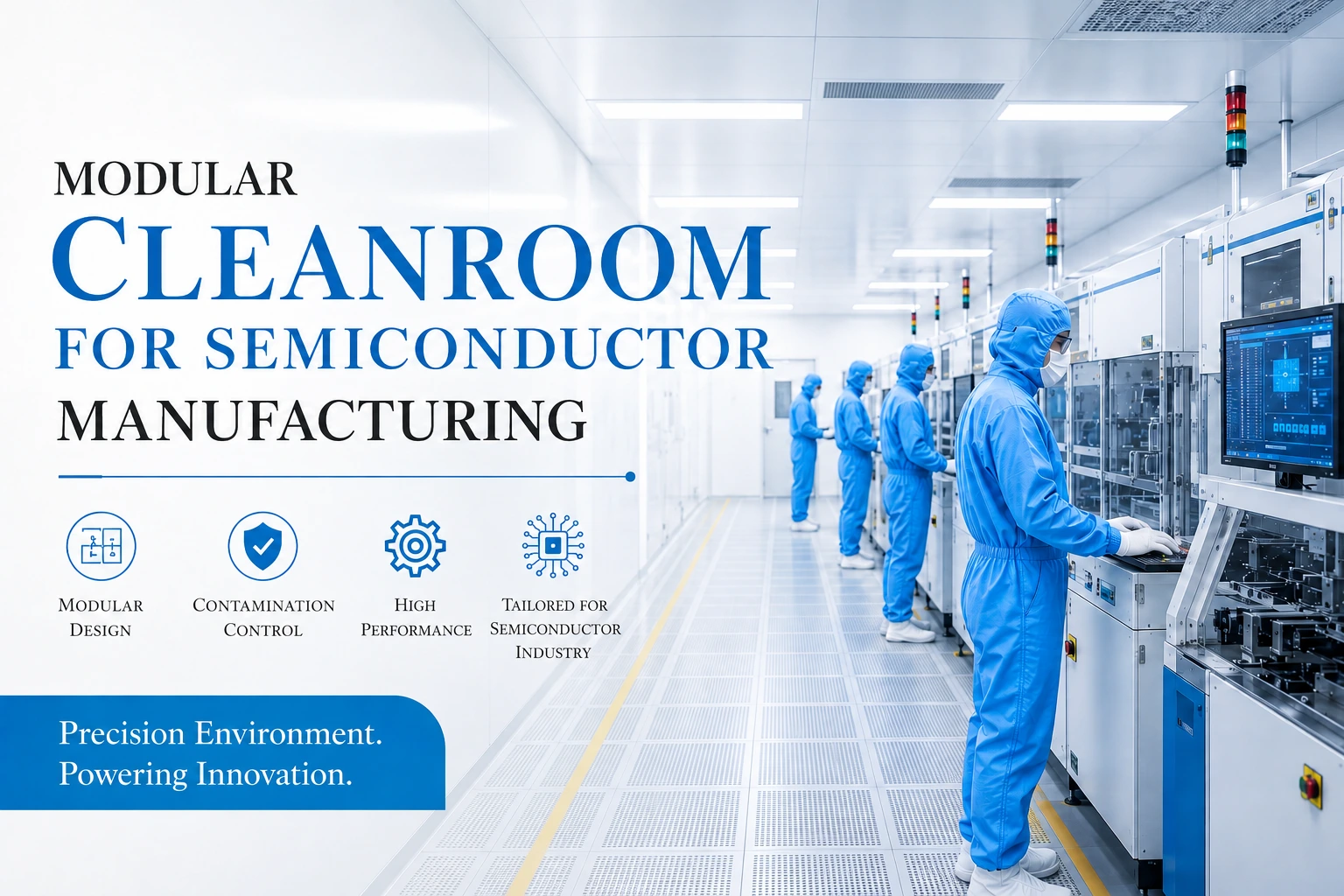
Semiconductor manufacturing operates at a level of precision where environmental control is part of the manufacturing process itself.
A tiny airborne particle can become a serious concern when it reaches a sensitive surface, wafer, component, or process area. As semiconductor geometries become smaller and manufacturing processes become more sophisticated, controlling contamination, airflow, temperature, humidity, pressure, vibration, and material movement becomes increasingly important.
This is where modular cleanrooms for semiconductor manufacturing can provide a practical advantage.
Unlike conventional construction, modular cleanroom systems are engineered from coordinated components such as wall and ceiling panels, doors, filtration systems, HVAC equipment, lighting, service interfaces, and monitoring systems. This approach can make it easier to create controlled production zones while also allowing the facility to adapt as manufacturing requirements change.
Why Modular Cleanrooms Matter in Semiconductor Manufacturing
But modular does not mean “basic” or “temporary.”
A properly engineered modular semiconductor cleanroom can be designed around the actual process requirements of the facility, including its required cleanliness classification, airflow strategy, environmental conditions, equipment layout, personnel movement, material flow, and future expansion plans.
What Is a Modular Semiconductor Cleanroom?
A modular semiconductor cleanroom is a controlled manufacturing environment constructed using prefabricated or standardized cleanroom components that are assembled into a coordinated system.
The system can include:
- cleanroom wall panels
- Cleanroom ceiling systems
- semiconductor cleanroom doors
- Viewing windows
- HVAC and air-handling systems
- HEPA or other specified filtration
- Air distribution systems
- Lighting
- Pressure-control systems
- Monitoring and instrumentation
- Service panels and utility interfaces
- Flooring systems
The major advantage is that these components can be designed together rather than treating the cleanroom as a conventional building with special finishes added later.
For semiconductor manufacturing, that distinction matters because contamination control begins with the overall facility design.
Why Do Semiconductor Facilities Need Cleanrooms?
A semiconductor cleanroom is designed to reduce and control environmental contamination that could interfere with sensitive manufacturing processes.
The exact requirements depend on the process. A wafer-processing environment, packaging area, inspection room, research laboratory, and equipment support area may not require identical conditions.
Important environmental considerations can include:
Airborne Particle Control
Particle concentration is one of the most visible cleanroom concerns. Air filtration and airflow design must work together to reduce the presence and movement of unwanted particles within critical areas.
Temperature and Humidity Control
Stable environmental conditions can be important for process consistency, equipment operation, materials, and chemical processes.
Differential Pressure
Pressure relationships between adjacent zones can help control the movement of air and contaminants between areas.
Personnel and Material Movement
People and materials can introduce contamination. Cleanroom design therefore needs to consider how operators, equipment, components, and consumables enter and move through controlled spaces.
Equipment Integration
Large semiconductor tools require carefully planned interfaces for utilities, exhaust, airflow, maintenance access, and movement.
Vibration Control
Certain semiconductor manufacturing and metrology equipment can be sensitive to vibration. The cleanroom should therefore be coordinated with the facility's structural and equipment requirements.
How Modular Cleanrooms Support Semiconductor Manufacturing
The biggest benefit of modular construction is not simply faster installation. Its real value comes from the ability to coordinate the physical cleanroom with the manufacturing process.
Flexible Cleanroom Layouts
Semiconductor facilities can have different process areas with different environmental requirements.
A modular approach can make it easier to create separate zones for:
- Manufacturing
- Assembly
- Inspection
- Testing
- Research and development
- Equipment support
- Material preparation
- Personnel entry
- Material transfer
Walls, doors, service interfaces, and other components can be planned around the production flow.
This helps avoid designing the cleanroom first and trying to force the manufacturing process into it later.
Controlled Airflow and Filtration
HVAC is one of the most important systems in a semiconductor cleanroom.
A cleanroom is not made clean simply by installing filters. The complete airflow strategy matters.
Depending on the application, the HVAC design may address:
- Air filtration
- Air distribution
- Air return paths
- Airflow direction
- Air changes
- Pressure relationships
- Temperature
- Relative humidity
- Heat loads from equipment
- Outdoor-air requirements
- Energy consumption
HEPA or other filtration technologies can be selected according to the required performance.
The actual filtration arrangement and airflow design should be determined through process requirements and engineering calculations rather than applying the same configuration to every semiconductor facility.
Better Contamination Control
Contamination control involves much more than airborne particles.
A well-designed semiconductor cleanroom considers potential contamination sources throughout the facility.
These can include:
- Personnel
- Equipment
- Materials
- Packaging
- Cleaning processes
- Maintenance activities
- Air movement
- Surface contamination
- Utility interfaces
This is why wall panels, ceilings, doors, floors, joints, penetrations, and equipment interfaces should be treated as part of one contamination-control strategy.
ISO 14644-9, for example, addresses assessment of particle cleanliness on solid surfaces, including walls, ceilings, floors, equipment and other surfaces within controlled environments.
Hygienic and Low-Particle Surfaces
The internal surfaces of a semiconductor cleanroom should be selected according to the process and cleanliness requirements.
Good cleanroom surfaces should generally be:
- Smooth
- Durable
- Easy to clean
- Resistant to the expected environment
- Appropriately sealed
- Designed to minimize particle accumulation
The material specification should also consider chemical exposure, cleaning procedures, static-control requirements, mechanical impact, and the particular process environment.
This is especially important because cleanroom performance is influenced by the complete installed system—not simply the panel material.
Modular Construction Supports Future Expansion
Semiconductor technology changes quickly.
A production facility designed around one process today may require additional equipment, different layouts, or increased production capacity later.
A modular cleanroom approach can support future changes through:
- Planned expansion zones
- Reconfigurable layouts
- Replaceable components
- Additional service interfaces
- Expansion-ready HVAC planning
- Adaptable internal partitions
However, future flexibility should be designed from the beginning.
A modular system does not automatically guarantee easy expansion. Structural planning, utilities, HVAC capacity, floor loading, equipment movement, and cleanroom zoning all need to be considered.
Faster Project Execution
One reason manufacturers consider modular cleanrooms is construction efficiency.
Many components can be manufactured or prepared before installation at the project site. This can reduce the amount of conventional construction work required inside the controlled environment.
Potential advantages include:
- Better installation planning
- Reduced on-site fabrication
- More predictable component quality
- Faster enclosure completion
- Easier coordination between trades
- Earlier transition toward commissioning
The actual project duration will still depend on the size and complexity of the facility, site conditions, HVAC scope, utilities, validation requirements, and procurement schedule.
Easier Maintenance and Upgrades
A semiconductor cleanroom is a long-term operating environment.
Panels, doors, filtration components, lighting, sensors, and other systems eventually require maintenance or replacement.
A modular design can make certain components easier to access, repair, or replace compared with permanently constructed assemblies.
This can be particularly valuable when maintenance work needs to be performed without unnecessarily disrupting adjacent production areas.
The facility design should therefore consider maintenance access from the beginning.
Environmental Monitoring
Modern semiconductor facilities increasingly depend on continuous environmental visibility.
Depending on the project, monitoring may include:
- Particle concentration
- Temperature
- Relative humidity
- Differential pressure
- Airflow
- Filter condition
- Equipment status
- Alarm conditions
Monitoring systems can be integrated with facility controls or a BMS where appropriate.
The purpose is not simply to collect data. Monitoring should help operators identify deviations early and support the facility's operating and maintenance procedures.
Material Selection for Semiconductor Cleanrooms
Material selection should be based on the actual process.
Common considerations include:
Wall and Ceiling Panels
Panel systems may use coated steel, stainless steel, aluminium-based materials, or other engineered surfaces depending on the application.
The selected system should be evaluated for:
- Surface cleanliness
- Chemical resistance
- Durability
- Particle generation
- Cleanability
- Static-control requirements
- Fire performance
- Joint and sealant compatibility
Flooring
Flooring must be compatible with the cleanroom's traffic, equipment, chemicals, cleaning procedures, and electrostatic-control requirements where applicable.
Sealants and Joints
Small construction details can become important contamination-control points.
Joints, corners, penetrations, door frames, and service interfaces should be properly designed and sealed.
ESD and Semiconductor Manufacturing
Electrostatic discharge can be an important consideration in electronics and semiconductor environments.
Where ESD control is required, the cleanroom design may need to coordinate:
- Flooring
- Workstations
- Personnel grounding
- Equipment
- Material handling
- Surface materials
- Environmental conditions
ESD protection should not be treated as a coating or flooring decision alone. It should be addressed as part of the facility's overall ESD-control program.
Vibration and Equipment Integration
Cleanroom construction and equipment installation cannot be planned independently for sensitive semiconductor facilities.
Certain tools may have strict requirements related to:
- Floor loading
- Vibration
- Utility connections
- Temperature stability
- Humidity
- Exhaust
- Maintenance clearance
- Equipment access
For this reason, cleanroom designers should coordinate closely with the equipment supplier, process team, structural engineer, HVAC team, and facility management team.
The cleanroom envelope is only one part of the overall manufacturing environment.
Cleanroom Classification for Semiconductor Manufacturing
There is no single cleanroom classification that applies to every semiconductor process.
The required classification should be established from the process risk and applicable project requirements.
ISO 14644-1 provides the framework for classifying air cleanliness by particle concentration. The appropriate class should therefore be selected based on what the manufacturing process actually requires.
This is an important distinction.
Instead of saying:
“Every semiconductor cleanroom must be ISO Class X.”
A better engineering approach is:
“The required cleanroom classification should be established according to the semiconductor process, equipment, product sensitivity, contamination risk and applicable specifications.”
This avoids over-designing the facility while still providing the required contamination-control performance.
Modular vs Conventional Cleanrooms
← Swipe table horizontally to view all columns →
| Factor | Modular Cleanroom | Conventional Construction |
|---|---|---|
| Installation | Prefabricated components can simplify installation | More site-based construction |
| Layout flexibility | High when designed for reconfiguration | Often more difficult to modify |
| Expansion | Can be planned into the system | May require more reconstruction |
| Maintenance | Components can be designed for accessibility | Depends heavily on construction |
| Project coordination | Requires detailed component planning | More traditional construction coordination |
| Future changes | Can be advantageous | Potentially more disruptive |
| Customization | High | High |
| Suitability for semiconductor use | Application dependent | Application dependent |
The important question is not whether modular construction is universally better.
The better question is:
Key Design Considerations Before Building a Semiconductor Cleanroom
Before starting a project, the facility team should define:
Process Requirements
What products and processes will be performed?
Cleanliness Requirements
What level of particle control is actually required?
Environmental Conditions
What temperature and humidity ranges are necessary?
Equipment Requirements
What are the equipment dimensions, heat loads, vibration limits, utility requirements and maintenance clearances?
Material Flow
How will raw materials, components and finished products move?
Personnel Flow
How will operators enter, gown, work and exit?
HVAC Requirements
What filtration, airflow, pressure and environmental-control strategy is required?
Future Expansion
Will production capacity or equipment requirements change?
Maintenance
How will filters, equipment, panels, sensors and other components be serviced without unnecessary disruption?
Answering these questions before finalizing the cleanroom layout can prevent expensive changes later.
Why Modular Cleanrooms Can Be a Strong Choice for Semiconductor Facilities
A well-engineered modular cleanroom can offer a combination of:
- Controlled contamination environment
- Flexible layout
- Scalable construction
- Coordinated HVAC integration
- Faster installation potential
- Easier component replacement
- Better future adaptability
- Efficient space planning
But these benefits depend on engineering quality.
A modular cleanroom should be designed around the semiconductor manufacturing process—not simply assembled from standard panels.
Why Choose Luckydeep for Semiconductor Cleanroom Solutions?
For semiconductor manufacturing, the cleanroom needs to work as part of a larger facility system.
At Luckydeep Cleanroom, our approach can combine modular cleanroom construction with HVAC and associated controlled-environment infrastructure.
Depending on the project, solutions can include:
- Modular Cleanroom wall panels
- Cleanroom ceiling systems
- semiconductor cleanroom doors
- View panels
- HVAC systems
- Air filtration systems
- Insulated risers
- Controlled-environment infrastructure
- Project planning and engineering
- Installation and commissioning support
Luckydeep's existing cleanroom portfolio includes modular cleanroom panels, Rockwool panels, semiconductor cleanroom doors, view panels and insulated risers, alongside HVAC capabilities. The company states that it provides planning, procurement, execution, commissioning, validation and handover as part of its project approach.
For a semiconductor project, the final configuration should be developed according to the manufacturing process, equipment requirements, cleanliness targets, environmental conditions and facility layout.
What Should You Ask a Semiconductor Cleanroom Manufacturer?
Before selecting a cleanroom partner, ask:
- Have you handled controlled environments for high-precision manufacturing?
- How will you determine the required cleanroom classification?
- How will the HVAC system be integrated with the cleanroom?
- What panel and surface materials are proposed?
- How will joints and service penetrations be sealed?
- How will equipment heat loads be considered?
- How will material and personnel flows be separated?
- How will future expansion be accommodated?
- What testing and commissioning activities are included?
- What documentation will be provided at project handover?