
Difference Between Conventional and Modular Cleanrooms
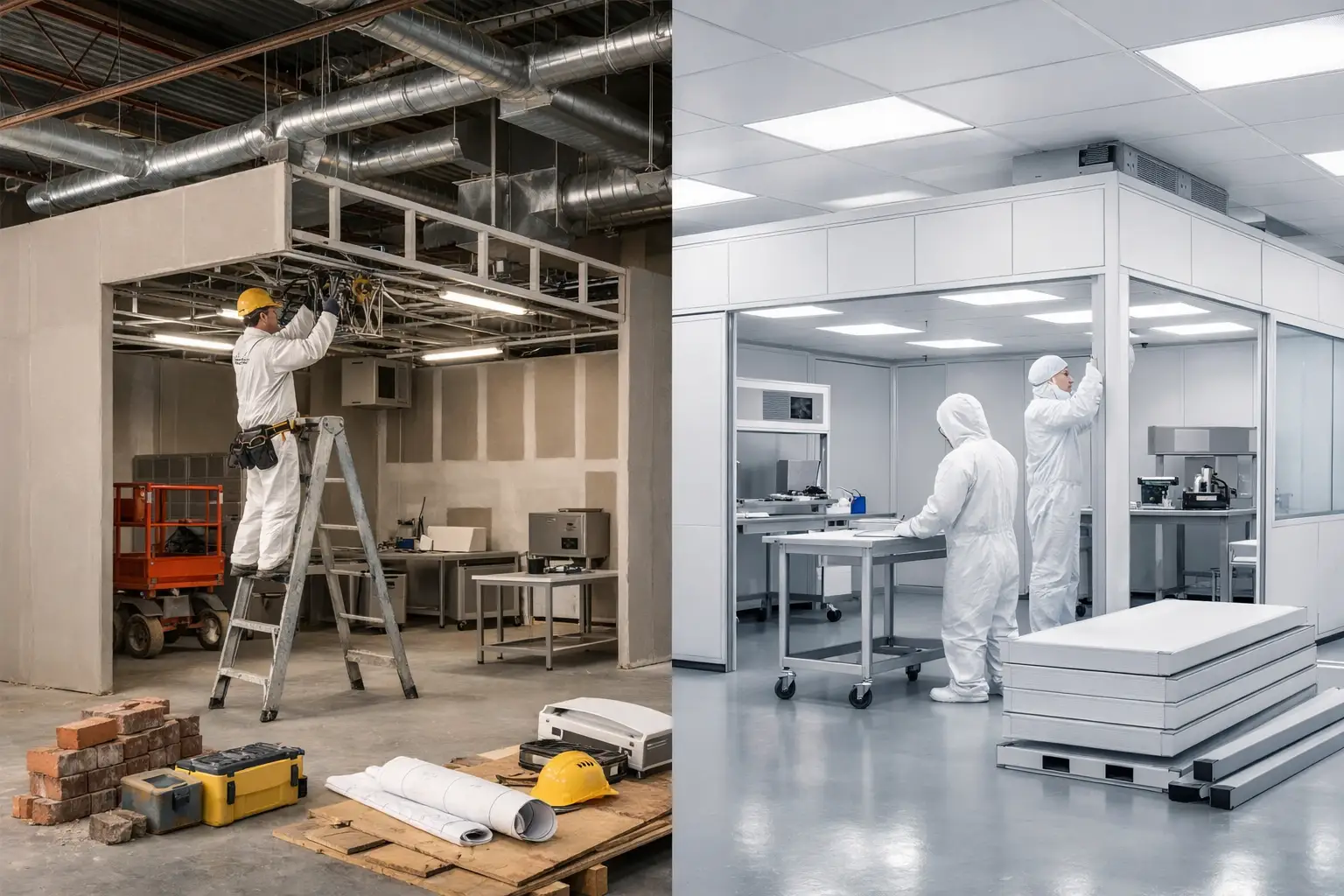
When industries like pharmaceuticals, biotechnology, semiconductors, and healthcare need highly controlled environments, cleanrooms become an absolute necessity. These specialized facilities are designed to maintain precise levels of air cleanliness, temperature, humidity, and pressure to ensure contamination-free production.
Traditionally, cleanrooms have been built using conventional construction methods, but in recent years, modular cleanrooms have emerged as a smarter, faster, and more cost-effective alternative. Many companies are now shifting towards modular systems because they offer flexibility, scalability, and compliance without the long delays of conventional setups.
In this blog, we will explain the key differences between conventional and modular cleanrooms, their pros and cons, and which option is the right fit for your business.
Understanding the Basics
Conventional Cleanrooms
Conventional cleanrooms are constructed much like permanent buildings. They use brickwork, drywall, concrete, and fixed HVAC systems. The design and construction process is lengthy, requiring architects, contractors, and specialized engineers. Once built, changes or expansions are complex and expensive.
Modular Cleanrooms
Modular cleanrooms are built using prefabricated panels, modular wall systems, and plug-and-play utilities. They can be installed much faster, easily expanded or relocated, and customized according to industry standards (ISO, GMP, FDA). Instead of being permanent structures, modular cleanrooms are flexible environments that grow with your needs.
Installation Time
- Conventional Cleanroom:Building a traditional cleanroom can take several months to more than a year. Design approvals, civil work, HVAC integration, and inspections delay the process.
- Modular Cleanroom:Modular systems are prefabricated and can be installed in weeks. For industries with urgent requirements, modular cleanrooms save critical time.
If speed-to-market is a priority, modular cleanrooms clearly win.
Flexibility & Scalability
- Conventional:Once built, conventional cleanrooms are difficult to expand or modify. If production demands increase, the only option is costly renovation or constructing a new facility.
- Modular:Modular cleanrooms are highly flexible. Panels can be added, removed, or reconfigured. Expansion is simple and doesn’t disrupt operations significantly.
For growing businesses, modular cleanrooms provide unmatched scalability.
Cost Considerations
- Conventional:High upfront construction costs, longer timelines, and higher operational expenses make them a heavy investment. Any changes later mean more expenses.
- Modular:Lower initial costs, faster installation, and reduced downtime lead to better ROI. Operational costs are often lower due to energy-efficient designs.
Modular cleanrooms are more budget-friendly and practical for startups and mid-sized companies.
Compliance & Standards
- Conventional:Compliance depends on the expertise of the construction team. If not designed precisely, achieving ISO or GMP standards can be challenging.
- Modular:Modular systems are designed to meet strict regulatory standards from the start. Prefabricated panels, HEPA/ULPA filtration, and HVAC systems are tested to meet ISO 5–8, GMP, and FDA guidelines.
If you want assured compliance, modular cleanrooms are the safer bet.
Design & Aesthetics
- Conventional:These cleanrooms often look like rigid, traditional labs. Design changes are difficult, and aesthetics are not a priority.
- Modular:Modern modular cleanrooms offer sleek, professional designs with clean finishes, concealed wiring, integrated panels, and ergonomic layouts.
Modular cleanrooms not only function better but also look modern and professional, which is crucial for industries hosting client inspections.
Maintenance & Repairs
- Conventional:Maintenance is complicated. Any repair in walls, HVAC ducts, or utilities often leads to downtime and contamination risks.
- Modular:Easy to maintain, as panels can be replaced individually. Utilities are often accessible without major disruption.
Modular cleanrooms reduce downtime and simplify maintenance.
Portability
- Conventional:These are permanent structures; relocation is impossible. If you move your facility, you cannot take the cleanroom with you.
- Modular:Fully relocatable. Panels and systems can be dismantled, transported, and reassembled at a new site.
Modular cleanrooms offer mobility that conventional ones never can.
Energy Efficiency
- Conventional:Often use older HVAC designs, leading to higher energy consumption.
- Modular:Built with energy-efficient HVAC, LED lighting, and better insulation. This reduces operational costs and environmental impact.
Modular cleanrooms offer mobility that conventional ones never can.
Long-Term Value
- Conventional:Suitable only if you need a permanent facility with no future expansion plans. They are robust but inflexible.
- Modular:Provide long-term value due to flexibility, cost-effectiveness, relocatability, and compliance.
Modular cleanrooms offer mobility that conventional ones never can.
Pros & Cons At a Glance
| Feature | Conventional Cleanroom | Modular Cleanroom |
|---|---|---|
| Installation Time | Months to a year | Few weeks |
| Flexibility | Rigid, hard to expand | Highly flexible |
| Cost | Expensive | Cost-effective |
| Compliance | Requires expertise | Pre-designed for ISO/GMP/FDA |
| Aesthetics | Traditional | Sleek, modern |
| Maintenance | Complex | Easy & low downtime |
| Relocation | Impossible | Fully relocatable |
| Energy Efficiency | High consumption | Energy-saving |
| Best For | Permanent, large-scale facilities | Dynamic, growing industries |
Which Cleanroom Should You Choose?
The choice between conventional and modular cleanrooms depends on your business goals:
- If you run a large, established facility with stable production needs and no plans for relocation, a conventional cleanroom may work.
- If you are a growing business, startup, or multinational company requiring scalability, speed, and compliance, modular cleanrooms are the future-proof option.
Why Industries Are Shifting to Modular Cleanrooms
- Faster project timelines
- Lower upfront investment
- Assured compliance with ISO & GMP
- Easy expansion and relocation
- Modern, sleek designs
- Energy efficiency and sustainability
This explains why pharma, biotech, electronics, and aerospace industries worldwide are making the switch.
Conclusion
Both conventional and modular cleanrooms serve the same ultimate purpose—providing contamination-free controlled environments. However, the way they are built, maintained, and scaled makes a significant difference.
- Conventional cleanrooms are suitable for permanent, long-term facilities with little need for flexibility.
- Modular cleanrooms,on the other hand, represent innovation, offering flexibility, cost savings, compliance, and scalability—all in one package.
At Luckydeep, we specialize in designing and manufacturing state-of-the-art modular cleanrooms tailored to your industry requirements. Whether you are a startup or a large-scale enterprise, our solutions provide the reliability, efficiency, and compliance you need to stay ahead.