
The Role of Cleanrooms in Solar Panel Manufacturing
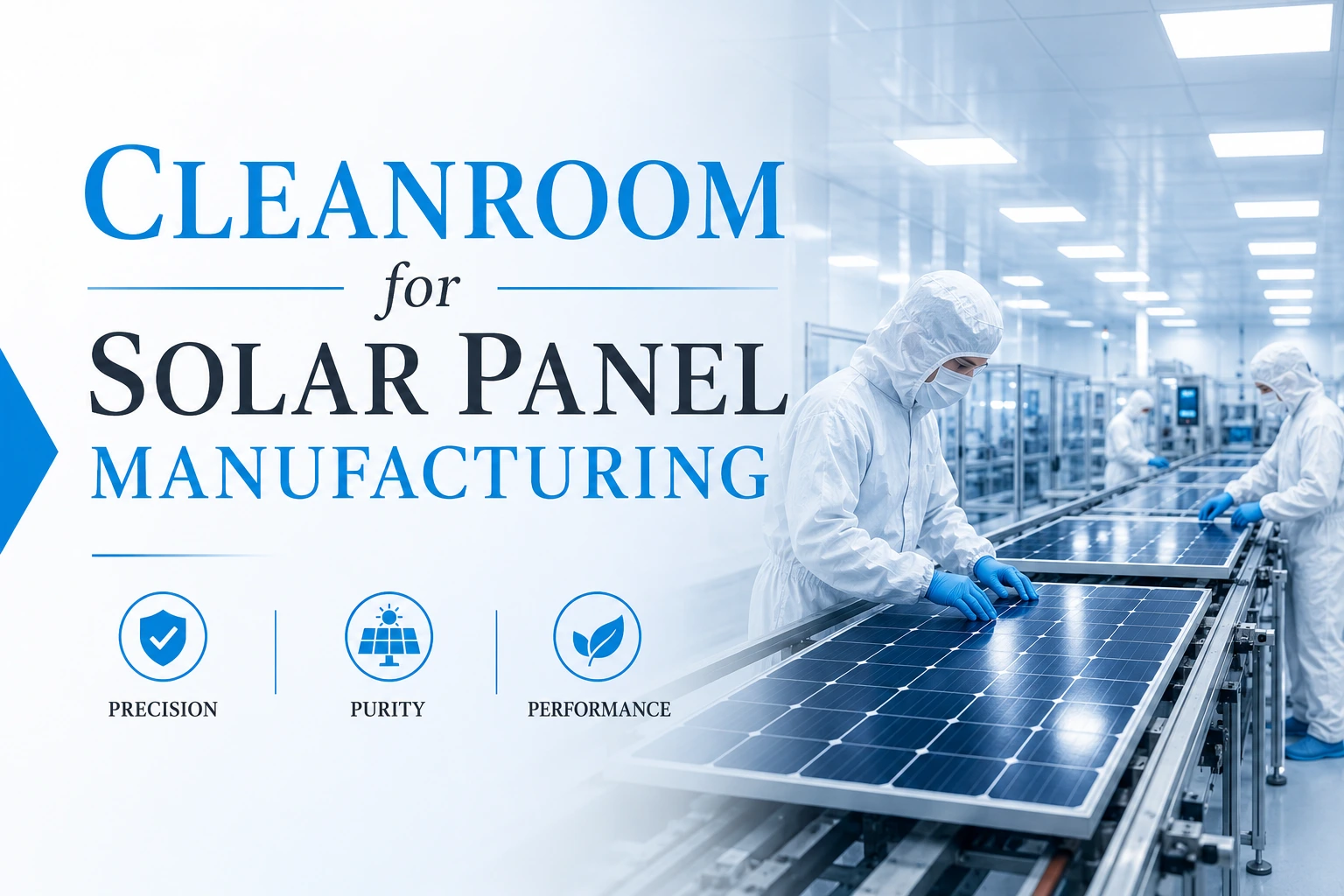
Solar panel manufacturing is becoming increasingly precise. As photovoltaic technologies evolve and manufacturers focus on higher efficiency, better reliability, and consistent production, controlling the manufacturing environment has become an important part of the process.
A solar cell may look robust once it becomes part of a finished module, but many of the processes involved in producing that cell are highly sensitive to contamination. Dust, airborne particles, chemical residues, humidity, and uncontrolled environmental conditions can affect surfaces, coatings, electrical properties, and ultimately product quality.
This is where cleanrooms for solar panel manufacturing become important.
A properly designed cleanroom provides controlled conditions around contamination-sensitive manufacturing processes. It can regulate airborne particles and support control of temperature, humidity, airflow, pressure, and other environmental parameters according to the requirements of the process.
However, not every stage of solar panel manufacturing necessarily requires the same level of environmental control. The right approach is to identify the contamination-sensitive processes and design the controlled environment around them.
This article explains the role of cleanrooms in solar panel manufacturing, where they are used, what they control, and the key factors manufacturers should consider when planning a clean manufacturing facility.
Why Are Cleanrooms Important in Solar Panel Manufacturing?
Solar cells are manufactured through a series of highly controlled processes involving silicon wafers, surface treatments, coatings, doping, deposition, metallization, and inspection.
During these stages, contamination can interfere with the surface or process chemistry.
Research on photovoltaic manufacturing has highlighted that silicon solar-cell production requires controlled environments because dust contamination can create defects and reduce performance.
A cleanroom helps reduce this risk by controlling the manufacturing environment rather than relying only on cleaning the product itself.
The objective is simple:
Keep contamination away from sensitive surfaces and processes.
That can help manufacturers achieve more consistent production, reduce contamination-related defects, and maintain the conditions required by their manufacturing process.
What Does a Cleanroom Control in Solar Manufacturing?
A cleanroom is not simply a room with filtered air.
It is an engineered environment designed to control specific conditions that can affect the manufacturing process.
Depending on the application, these may include:
- Airborne particle concentration
- Temperature
- Relative humidity
- Airflow
- Air pressure
- Air filtration
- Surface contamination
- Personnel movement
- Material movement
- Chemical or molecular contamination
ISO 14644 provides a framework for cleanroom classification based on airborne particle concentration. The required cleanliness level should be determined by the process and contamination risks rather than automatically applying the same classification throughout an entire facility.
This is particularly important for solar manufacturing because different production stages can have different environmental requirements.
Where Are Cleanrooms Used in Solar Cell Manufacturing?
The requirement for controlled environments depends on the solar technology, process architecture, equipment, and contamination sensitivity.
Solar-cell manufacturing can include processes such as:
- Wafer preparation
- Surface cleaning
- Surface texturing
- Diffusion
- Doping
- Passivation
- Thin-film deposition
- PECVD processes
- PVD processes
- Metallization
- Inspection and metrology
- Cell testing
The U.S. Department of Energy describes solar-cell manufacturing as involving processes such as chemical wafer texturing, doping, surface coatings, and metallization.
Some of these processes are particularly sensitive to particles and chemical contamination.
Therefore, cleanroom planning should start with the process flow, not simply with the size of the building.
Wafer Preparation and Surface Processing
Silicon wafers are among the most important components in crystalline silicon solar-cell manufacturing.
Before a wafer becomes a functioning solar cell, its surface may undergo several preparation and treatment steps.
These processes can be sensitive to particles and surface contamination.
A particle deposited on a wafer can potentially interfere with subsequent processing, surface treatments, or coatings.
A controlled environment can therefore help protect wafer surfaces during sensitive manufacturing stages.
Surface Texturing and Chemical Processing
Surface texturing modifies the wafer surface to improve its optical properties.
Chemical processes may also be used for cleaning, etching, and preparing surfaces for subsequent steps.
At these stages, contamination control is important because unwanted particles or residues can interfere with surface quality and process consistency.
The cleanroom environment should therefore be coordinated with the chemical process, equipment design, ventilation requirements, and material-handling strategy.
Doping and Diffusion Processes
Doping changes the electrical properties of silicon and is a critical part of solar-cell manufacturing.
Because the electrical characteristics of the cell depend on controlled material properties, process contamination needs to be carefully managed.
The cleanroom itself does not perform the doping process. Instead, it provides a controlled manufacturing environment around the equipment and process.
This distinction is important when designing a solar cell manufacturing cleanroom.
The cleanroom should support the process rather than be treated as a standalone construction element.
Thin-Film Deposition and Coating
Thin-film processes involve depositing extremely thin layers onto a substrate.
Processes such as PECVD and PVD may be used depending on the solar-cell technology.
At this stage, unwanted particles or chemical contamination can affect the uniformity and quality of deposited layers.
Clean manufacturing conditions can help reduce the risk of particles reaching sensitive surfaces during deposition and subsequent handling.
For advanced photovoltaic manufacturing, environmental control may therefore become an important part of maintaining process consistency.
Metallization and Cell Processing
Metallization creates the electrical contacts required for collecting current from the solar cell.
At this stage, consistency matters.
Contamination or process variation can contribute to defects that affect electrical performance or production yield.
A controlled environment can support consistent processing conditions and reduce contamination risks around sensitive manufacturing equipment.
Cleanroom Air Quality and Solar Cell Performance
One of the most important reasons for using cleanrooms in photovoltaic manufacturing is controlling airborne contamination.
Particles can settle on sensitive surfaces during processing.
According to ISO guidance, particle deposition on contamination-sensitive surfaces is directly related to the risk of airborne particle contamination. ISO 14644-17 specifically addresses particle deposition rates and their relationship with contamination-sensitive products.
For solar manufacturing, this matters because a wafer or coated surface may be exposed during several process steps.
The objective is not simply to make the room look clean.
The objective is to control contamination where it can affect the product or process.
Do Solar Panel Factories Need the Same Cleanroom Everywhere?
No.
This is one of the most important points when planning a photovoltaic manufacturing facility.
Different manufacturing areas can have different contamination sensitivities.
For example, a highly sensitive cell-processing area may require tighter environmental control than a less contamination-sensitive support area.
Published photovoltaic manufacturing research has described production environments using combinations of ISO 7 and ISO 5 areas, with specific processes requiring cleaner zones.
The exact classification should be established through process requirements, contamination risk assessment, equipment requirements, and the applicable standards.
There is no universal cleanroom classification that is automatically correct for every solar manufacturing facility.
Key Cleanroom Systems for Solar Manufacturing
A solar manufacturing cleanroom is an integrated system.
Important components can include:
HVAC System
The HVAC system controls and distributes conditioned air throughout the cleanroom.
Depending on the process, it may need to manage:
- Temperature
- Humidity
- Airflow
- Pressure
- Air changes
- Heat loads
HEPA Filtration
HEPA filtration can be used where the process requires high-efficiency removal of airborne particles.
The filtration strategy should be matched to the required cleanliness level and room design.
Cleanroom Panels
Walls and ceilings should provide smooth, cleanable surfaces and appropriate sealing.
Panel selection should consider:
- Cleanability
- Chemical exposure
- Durability
- Surface finish
- Joint design
- Maintenance requirements
Airflow Management
Simply installing filters does not guarantee effective contamination control.
Airflow needs to be designed around the room layout, equipment, personnel movement, and process.
Poorly planned airflow can create turbulence or dead zones where contaminants can accumulate.
Pressure Control
Pressure relationships between adjacent areas can help control the movement of air and contamination.
The pressure strategy should be developed together with the facility's zoning and process requirements.
Personnel and Material Flow
People and materials can introduce contamination into controlled areas.
Therefore, the design should consider:
- Personnel entry
- Gowning
- Material entry
- Airlocks
- Pass boxes
- Equipment movement
- Waste movement
Good flow design can reduce unnecessary movement and support cleaner operations.
Cleanroom Design for Solar Panel Manufacturing
A successful solar manufacturing cleanroom starts with process mapping.
Before selecting panel materials or HVAC equipment, manufacturers should understand:
What Is the Manufacturing Process?
Identify every contamination-sensitive stage.
Which Processes Require Controlled Environments?
Not every room necessarily needs the same cleanliness level.
What Are the Equipment Requirements?
Equipment heat loads, exhaust requirements, utilities, access, and maintenance space should be considered.
What Environmental Conditions Are Required?
Determine temperature, humidity, airflow, pressure, and cleanliness requirements.
How Will People and Materials Move?
Create separate and controlled movement paths where necessary.
What Are the Maintenance Requirements?
Filters, HVAC equipment, lighting, utilities, and other systems require planned access.
Can the Facility Expand?
Solar manufacturing capacity can change significantly over time. Future expansion should be considered during initial planning.
Why Cleanroom Design Affects Manufacturing Efficiency
A cleanroom should not only control contamination.
It should also support efficient production.
Poorly planned layouts can create:
- Unnecessary material movement
- Longer production routes
- Difficult maintenance access
- HVAC inefficiencies
- Higher operating costs
- Increased contamination opportunities
A well-planned facility brings process engineering, cleanroom engineering, HVAC, material flow, and maintenance requirements together.
The result is a manufacturing environment designed around how the facility actually operates.
Cleanrooms and the Future of Solar Manufacturing
The photovoltaic industry continues to develop new cell architectures, materials, coatings, and manufacturing methods.
As processes become more precise, environmental control can become increasingly important.
This does not necessarily mean that every future solar factory will require the cleanest possible environment.
Instead, the focus is likely to remain on process-specific contamination control.
The most effective approach is to determine where contamination can affect yield, efficiency, reliability, or process stability and then design the appropriate controlled environment around those risks.
This can also help manufacturers avoid over-engineering areas that do not require stringent cleanroom conditions.
What Should Solar Manufacturers Consider Before Building a Cleanroom?
Before starting a new cleanroom project, ask these questions:
- What solar technology will be manufactured?
- Which processes are contamination-sensitive?
- What cleanliness classification is required?
- What temperature and humidity ranges are needed?
- What HVAC capacity is required?
- What type of filtration is appropriate?
- How will personnel enter the controlled areas?
- How will wafers, materials, and equipment move?
- What chemical exhaust systems are required?
- How will maintenance be performed?
- What testing and commissioning will be required?
- Is future production expansion planned?
Answering these questions before construction can prevent expensive design changes later.
Why Choose an Experienced Cleanroom Partner?
A solar manufacturing cleanroom involves much more than wall panels.
The project may require coordination between:
Cleanroom design + HVAC + filtration + airflow + pressure control + panels + utilities + process equipment + material flow + testing
An experienced cleanroom partner should understand how these systems interact.
For a photovoltaic manufacturer, the objective should be to create a controlled environment that supports the actual manufacturing process rather than simply installing a standard cleanroom package.
Cleanroom Solutions for Solar and Photovoltaic Manufacturing
At Luckydeep Cleanroom, cleanroom solutions can be developed around the specific requirements of advanced manufacturing environments.
For solar and photovoltaic applications, the focus should be on understanding the process, identifying contamination-sensitive areas, and coordinating cleanroom infrastructure with HVAC, filtration, airflow, equipment, utilities, and operational requirements.
A project-specific approach can help manufacturers create controlled environments suited to their production process rather than relying on a one-size-fits-all cleanroom design.
Luckydeep's cleanroom expertise can support manufacturers looking to develop or upgrade controlled manufacturing environments for advanced industrial applications.